Sail
35,852 $
Mcintosh Offshore Cutter
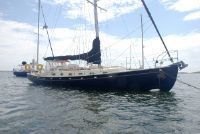
\"SAIORSE\" (pronounced \"Say-er-sha\") is the gaelic word for Liberty and is also the name of the first Irish sailboat to circumnavigate the world (1923). \"SAIORSE\" is a moderate displacement cruiser built of steel. She was designed by naval architect \"Bud\" McIntosh, whose book \"how to build a wooden boat\" is well known. He designed many boats and worked in Maine in the 1930-40\'s. This boat is his \"Merry Wing\" design. She was built in steel by Treworgy Yachts in Florida. She was built for the Maine Schoonerman Herb Smith who had circumnavigated in a 55 footer of McIntosh design. He had this boat built for a solo circumnavigation. Upon completion of the hull and deck, she was sailed up to Maine. Herb’s plans having changed, she was sold to the current owner. She was finished off by the apprentices of the Maine Maritime Museum in Bath, Maine. Please read the \"full specs.\" for the complete history of this wonderful design as well as all about her sailing characteristics. \"SAIORSE\" (pronounced \"Say-er-sha\") is the gaelic word for Liberty and is also the name of the first Irish sailboat to circumnavigate the world (1923). \"SAIORSE\" is a moderate displacement cruiser built of steel. She was designed by naval architect Bud McIntosh, whose book \"how to build a wooden boat\" is well known. He designed many boats and worked in Maine in the 1930-40\'s. This boat is his \"Merry Wing\" design. She was built in steel by Treworgy Yachts in Florida for the Maine Schoonerman Herb Smith who had circumnavigated in a 55 footer of McIntosh design. Upon completion of the hull and deck, she was sailed up to Maine. Herb’s plans having changed, she was sold to the current owner. She was finished off by the apprentices of the Maine Maritime Museum in Bath, Maine. The supervisor of the project was Phil Shelton, who later circumnavigated himself in a 50 footer of Bolger design.
The design is a full keel with cut-away forefoot and attached rudder. As you can see from the LWL, she has fairly short overhangs. She has a very kindly motion at sea and tracks like a train on rails. She has a steering wind vane which does all the work of steering the boat once she has been settled on her course. This works far better than another crew member, as it is always alert, always working and does not complain or consume any food or drink!
The boat is not a big 40 footer and can easily be handled singly or by a couple. she is cutter rigged and carries a 125% jib on a Profurl furling system. The staysail is hanked on the inner stay. The mainsail is fully battened and is reefed by slab reefing. A gallows makes reefing easy and safe. One simply drops the boom onto the gallows and it no longer swings around endangering everyone.
She has a fiberglass dodger with Eisenglass windows which keep the crew very cozy in the cockpit.
Down below is finished in cherry. A forward queen-sized double berth is surrounded by ample lockers.
On the port side aft of the forward stateroom is the head which contains a shower.
The main salon has a large midline folding table which easily seats six people. This is fiddled and the center section of the table contains four vertical lockers for the precious items such as a bottle of wine for dinner? Port and starboard bunks and a well equipped navigation station complete the main salon.
To port as one descends the companionway, is the galley which contains a three burner stove and oven, a Sea-Frost fridge and freezer which is driven off a compressor by the engine; and ample storage for the dishes, cups and glasses.
To starboard is a cedar-lined hanging locker and a stack of 6 drawers for domestic use. A quarterberth to starboard allows room for a small person.
There is very ample locker space and storage throughout the vessel.
She was launched in 1995 and sailed down to Hyannis, MA. which is her home port. She has been cruised up and down the coast here in the North East as a family boat. She has sailed to Bermuda twice as a participant in the Marion-Bermuda race. Her motion at sea is very solid, safe and kindly. If the wind is light, less than 10 knots, she will foot along at 3-4 knots under the 150% genoa. With a wind of 10-15 knots, she will quickly get up to 5-6 knots under the working sail, the 125% jib. On a reach in winds of 12-20 knots she is in her element and will sail at 6-7.5 knots without any water coming on deck.
In weather above twenty knots, the call is to shorten sail by furling the jib a little as well as putting in one reef in the main. Above 25 knots a second reef in the main and a shortened jibe with the hanked on staysail brings the whole rig down and towards the center of the boat, eliminating all weather helm.
Features:
TypeSail
CategoryCutter
MakeMcintosh
ModelOffshore Cutter
Year built1991
Length39.99ft
Hull MaterialSteel
Beam11.52ft
Draft5.25ft
Type keel:Full keel
New/UsedUsed
FuelDiesel