Sail
4,765 $
Paper Jet Standard Rig 14
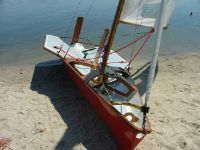
.Designer\'s comments The Paper Jet is designed primarily as a training boat, with the intention that it can cater for a wide range of sailing skills. I wanted a boat that will allow a club to race it as a class boat that will give exciting sailing to those who have the skills but will also allow less experienced sailors to develop their sailing skills in the same boat at a much lower level of performance. It is not suited for learning the most basic sailing principles single-handed. We recommend double-handed training until the student has enough expertise to sail single-handed. For single-handed training first learn the basics on a Sunfish or similar boat then move to the more performance oriented Paper Jet. The same features that I designed into it for club use will allow a family to use one hull as the platform on which Dad can have his excitement of blasting across large expanses of water but junior can sail the same boat (if he can pry it loose from Dad\'s grip) with a smaller rig and at slower speed. It is a boat that needs agility and quick responses. I don\'t recommend it for anyone who is slowed by arthritis or other physical problems. I did not try to produce a design that will sail the pants off any of the other skiffs or single-handers. It is fast and it is exciting to sail with the Turbo rig, but from the outset (this boat was in the back of my head for over 10 years) it was intended to provide an economical path for sailors to progress between boats like the Optimist and the costly single-handed skiffs without having to trade up their boat each time to go the next step. They can build a Paper Jet at the cheapest level or the level that they think that they can handle and progress from there. Meanwhile, as long as Dad is not out sailing, the kids can use the same boat at a more basic level. It makes sailing more viable for many families. With time and skill improvements they can move into more costly boats if they feel the need. Hull construction is stitch & glue plywood with a difference. The entire boat is built from 4mm plywood, so it is very light and needs more internal support than is normal with thicker plywood. I did this by fabricating a full-length plywood ladder-frame backbone that has interlocking transverse plywood frames. This necessitated securing the framework to building stocks for rigidity until the hull skin was complete. After completing the hull skin, it can be released from the building stocks for the remainder of the work. The stocks continue to serve as a support for working on the boat either right way up or upside down, depending on the work that is being done. This keeps it at a convenient and comfortable working height. The detailing that I worked into this design is simple but it gives loads of opportunity for showing off your woodworking and finishing skills. I used cedar for lightness along gunwales and for the wing leading edges but capped them with poplar to give a nice contrast while adding strength and stiffness to the structure. The result is a very light boat (hull/deck weight less than 100lb) that is also very stiff. The hull shape is hard chine, with a V-bottom that twists from vertical at the bow to almost horizontal at the transom. The wings are intentionally low and horizontal so that the leeward rail will immerse if the boat is over-powered in gusts, adding buoyancy to leeward to help her recover. The wings have airfoil shaped leading edges to generate lift, also to help her to recover. Most skiffs have wings that can trip the boat if immersed, causing a capsize. These wings are designed to cancel out that tendency and also serve as additional planing surfaces.
Features:
TypeSail
CategoryRacers
Daysailers
MakePaper Jet
ModelStandard Rig 14
Year built2006
Length14.01ft
Hull MaterialComposite
Beam5.31ft
Draft2.66ft
New/UsedUsed